TCF, TEF, DELF or DALF: which French test should you choose?
Test or diploma, the versions of the TCF and TEF, the role of the DELF and DALF: how to choose the French exam your application actually requires.
Read articleThe six HSK levels, the three real difficulties of Mandarin (tones, characters, production) and a level-by-level preparation method.
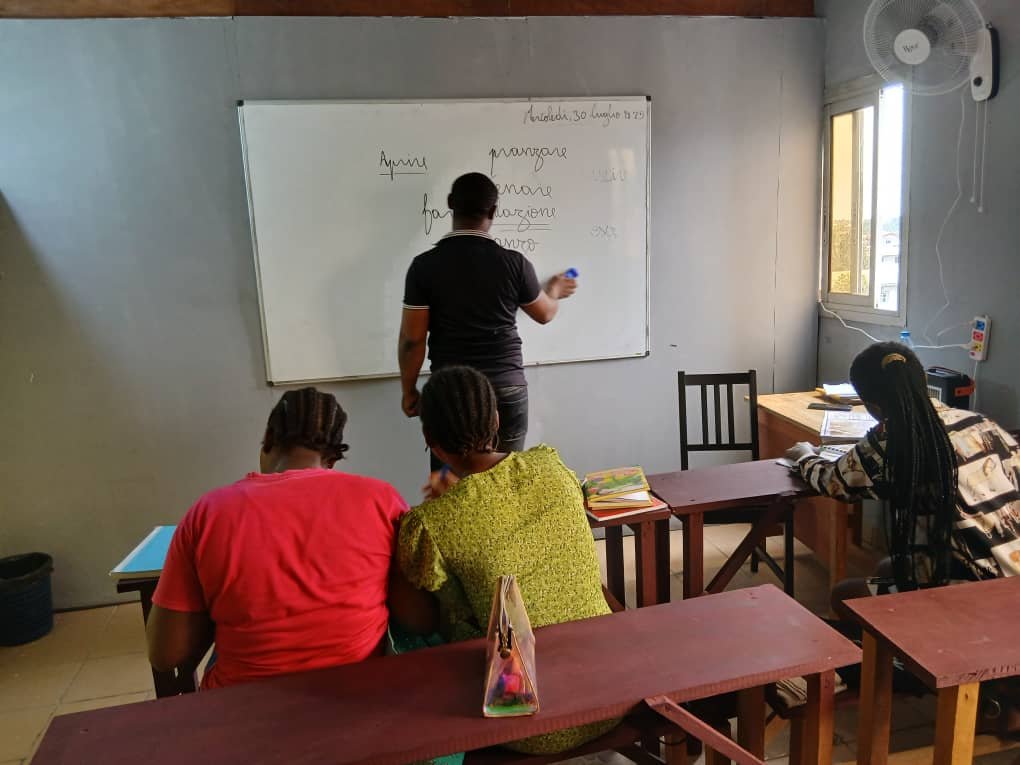
Chinese attracts a growing number of learners in Cameroon, driven by trade, study grants and professional opportunities linked to China. And contrary to a common belief, the path is very well marked: the HSK structures learning from beginning to end.
Le HSK (Hanyu Shuiping Kaoshi) is the official exam of Mandarin Chinese comprehension and use for non-native speakers. It is organised into six levels, from HSK 1 to HSK 6.
Its distinctive feature: it does not merely assess, it structure. Each level corresponds to a defined set of characters and grammar points. Learning Chinese “for HSK 3” means following a precise syllabus — which makes progress far more legible than in other languages.
You learn pinyin, the tones, the most frequent characters, and everyday sentences: introducing yourself, counting, asking a price, talking about your family.
What is at stake in these two levels is not vocabulary but the tons. Mandarin has four, plus a neutral tone, and they change the meaning of the word. A tone badly installed at the start is hard to correct later.
This is where Chinese becomes a usable language. You hold a conversation on familiar topics, read short texts and write simple messages.
HSK 4 is frequently cited as the threshold for routine professional exchanges, and it appears in some scholarship applications. It is also the level where the number of characters to master rises sharply: regularity becomes decisive.
You read the press, follow a film, write structured texts and take part in specialist discussions. These levels target higher education in China and posts demanding genuine linguistic autonomy.
Starting Chinese? At PVT Institut the Chinese syllabus is structured directly by HSK level, textbooks provided.
This is the most underestimated and most expensive difficulty. Work on them from day one, out loud, imitating rather than analysing. Record yourself: the gap between what you think you are producing and what you actually produce is often large.
Chinese writing is intimidating, but it follows a logic: characters are built from recurring radicals. Learning the radicals turns memorisation from brute effort into recognition work.
The key point is regularity: fifteen minutes a day beats three hours on a Saturday. Character memory is built through spaced repetition.
Many learners can read a character without being able to write it, or understand a sentence without being able to form it. The HSK tests both: train production, not only recognition.
This is the rarely mentioned counterweight. Chinese has no conjugation, no gender, no agreement, no declension. A verb keeps the same form whatever the subject or tense; time is expressed through markers and context.
For a French-speaking learner used to irregular conjugations, that economy is a real relief. The effort shifts to pronunciation and writing, but sentence construction is picked up quickly.
The answer depends on your plan. If you are aiming at studies in China, a post in a Chinese company or trade with Chinese partners, a certified HSK is a strong and relatively rare signal on the Cameroonian market.
If your goal is a move to Europe or North America, certified English, German or French will be more directly useful. Our article on choosing a language for your move abroad compare ces options.
The HSK organises Chinese learning into six legible levels. Tones and characters demand regularity; the grammar is simpler than people expect. Choose the level that serves your plan and work through it without skipping stages.
PVT Institut teaches Chinese from HSK 1 to HSK 6 in Rails-Bonaberi, textbooks included. For a placement test, contact the institute.
PVT Institut teaches English, French, German, Italian and Chinese in Rails-Bonaberi, Douala.
Test or diploma, the versions of the TCF and TEF, the role of the DELF and DALF: how to choose the French exam your application actually requires.
Read articleAcademic or General, what each paper measures, what really costs you marks, and a four-step preparation method.
Read articleThe real differences between the Goethe-Zertifikat, TELC, ÖSD and TestDaF, and how to choose the certification that matches your application rather than your preference.
Read article